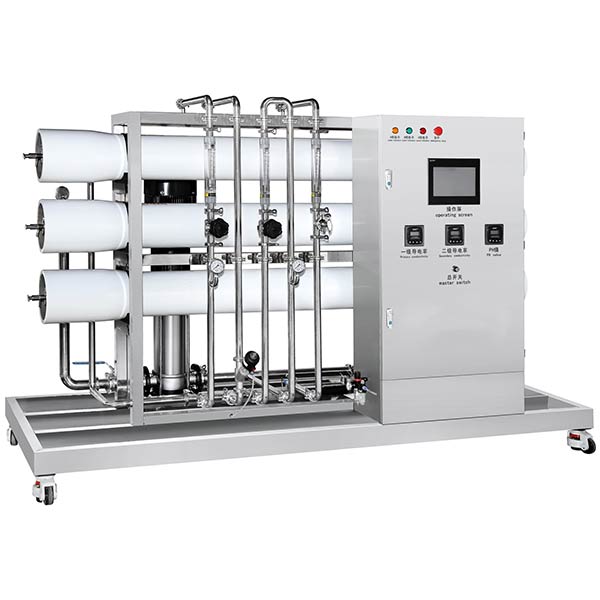

Ro Water Treatment reverse osmosis Equipment
Application
Separate pure water from a solution containing solutes using a semi permeable membrane that can only pass through water. At this point, the water on the pure water side spontaneously penetrates the semi permeable membrane and enters the solution side, causing the water level on the solution side to rise. This phenomenon is called permeation. When the liquid level rises to a certain height, the pressure on both sides of the membrane reaches equilibrium, and the liquid level on the solution side no longer rises. At this point, there is a pressure difference on both sides of the membrane, called osmotic pressure. If a pressure greater than the osmotic pressure is applied to the solution side, the water molecules in the solution will be squeezed to the pure water side, which is exactly the opposite of osmosis. We call this reverse osmosis (RO). We can see from the process of reverse osmosis that due to pressure, water molecules in the solution enter pure water, increasing the amount of pure water while the solution itself is concentrated.
The reverse osmosis membrane used in reverse osmosis equipment is a semi permeable spiral wound membrane. When raw water is sent to the reverse osmosis membrane at a certain pressure, the water passes through the small pores on the membrane and is collected to obtain pure water. Impurities in the water, such as soluble solids, organic matter, colloidal substances, and bacteria, are intercepted by the reverse osmosis membrane and concentrated in the intercepted liquid before being removed. Single stage reverse osmosis can remove over 97% of dissolved solids in raw water, while two-stage reverse osmosis can remove over 99% of dissolved solids, over 99% of organic matter and colloids, and almost 100% of bacteria. The two-stage reverse osmosis equipment uses pure water from one to enter the second as raw water, which can achieve higher quality of the produced pure water. It is suitable for the production of high-purity water and can also be used in situations where the conductivity of the raw water is high.
Reverse osmosis equipment is currently one of the advanced devices in the world for producing pure water in water treatment equipment. Its operating cost is low, economical, easy to operate, and reliable. The production capacity of the equipment is the value at 25 ℃ of raw water and standard production conditions. Changes in water temperature and production conditions will affect the production capacity of the equipment.
Characteristics of single-stage reverse osmosis process:
Suitable for areas with low salt content in raw water
Low total carbon content (organic matter) in water production
The structure is relatively simple
Characteristics of dual stage reverse osmosis process:
Suitable for areas with high salt content in raw water
The conductivity of the produced water is good
● Low one-time investment
● Low operating costs
● Good stability
Main performance of reverse osmosis membrane:
● Comprehensive desalination rate>97-99%
Effective removal of organic matter with a molecular weight cut-off of>150MW
Bacterial removal rate>99%
● Pyrogen removal rate>99%
Silicon dioxide removal rate>98.5%
● Removal rate of heavy metal ions>96~99%
Contact:Tony Zhu
Sunhang Pharmaceutical Machinery Co., Limited
Room1101, Building No.8, Lane875 Huanlin Rd(E), Shanghai, China
Tel: +86 21 50656741, Mobile: 0086-13917598598
E-mail: shpm88@sunhang.com
Website: www.sunhang.com, www.sunhang.net
Whatsapp/Wechat/Instagram:+86-13917598598
Skype/Facebook/Whatsapp:shpm168